Product File
Label & Quality File: Reading an Omega-3 Fish Oil 1200 mg Softgel
A public product page for an omega-3 fish-oil softgel illustrates why the front-of-pack fish-oil number, total omega-3 amount, EPA+DHA amount, serving size, and a verification mark are separate pieces of information.
We distinguish documented facts, reasonable inferences and missing information. Educational only; not medical advice.
Label & Quality File · 8 November 2026 · Sources: manufacturer product page and USP’s description of its Verified Mark.
This file uses a public Nature Made Fish Oil 1200 mg product page as a label-reading example. It is not a product recommendation, an assessment of a particular lot, or evidence that a supplement will have a particular health effect.
Start with the serving, not the front number
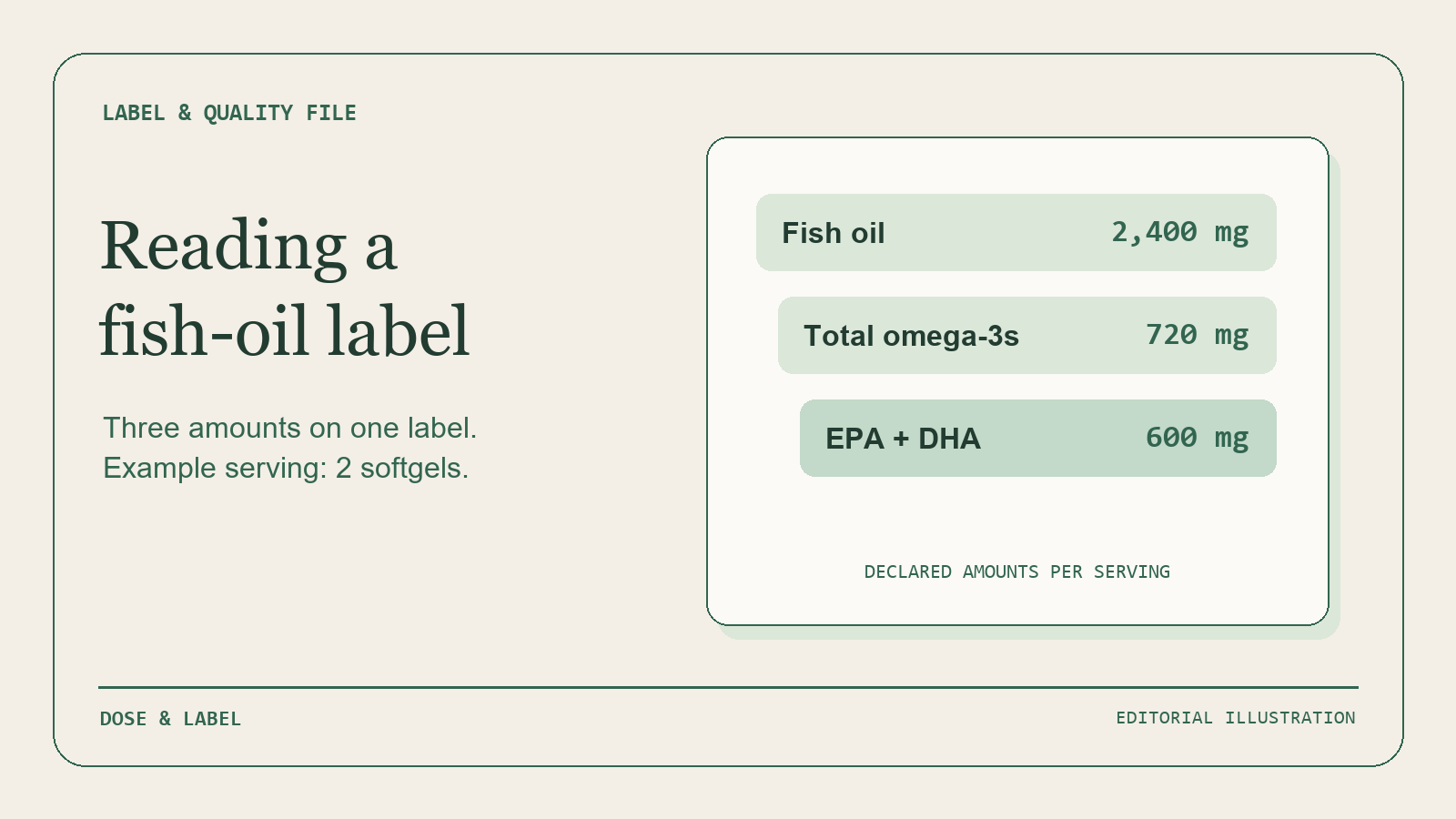
The product page describes a serving as two softgels. It lists 2,400 mg fish oil and 720 mg total omega-3 fatty acids per serving. That means the familiar “1,200 mg” describes the fish-oil amount per softgel; it is not the same as 1,200 mg of total omega-3s, EPA, or DHA.
The same page states 600 mg of EPA and DHA combined per serving. The remaining listed omega-3 amount is not automatically EPA or DHA. A useful reading habit is to keep four fields separate: serving size, total oil, total omega-3s, and the named fatty acids.
What a quality mark changes—and what it does not
The product page displays a USP Verified mark. USP says its dietary-supplement verification program includes review of manufacturing and quality-control documentation, testing against applicable specifications, manufacturing-facility auditing, and off-the-shelf testing. USP also says its mark is intended to indicate that the listed ingredients and declared amounts were verified and that specified contaminants were within its program’s limits.
That is quality information, not a blanket finding of effectiveness or a substitute for individual medical advice. USP explicitly distinguishes verification from a comprehensive assessment of whether a supplement will be effective for a particular person or purpose.
What remains unavailable from a public label
A label and a verification mark do not normally provide a batch-specific certificate of analysis, the numerical result for every oxidation test, or the complete history of a product’s raw materials. Those may require a current lot document from the manufacturer, if it is made available. They also do not tell a reader whether the amount is appropriate for that reader.
The practical takeaway is modest: compare like with like. First convert the label to the stated serving; then distinguish fish oil from total omega-3s and EPA+DHA; finally, treat a third-party mark as evidence about the scope the verifier describes—not as a shortcut to every quality or health question.
Read the public product page and USP’s verification description for the underlying details.