Label Literacy
Serving Size Is a Labeling Unit, Not a Personalized Dose
On a Supplement Facts panel, serving size tells you how the label groups information. It does not decide what is suitable for an individual.
We distinguish documented facts, reasonable inferences and missing information. Educational only; not medical advice.
The first numbers on a Supplement Facts panel are easy to skip: serving size and servings per container. They are also the key to interpreting every amount printed below them.
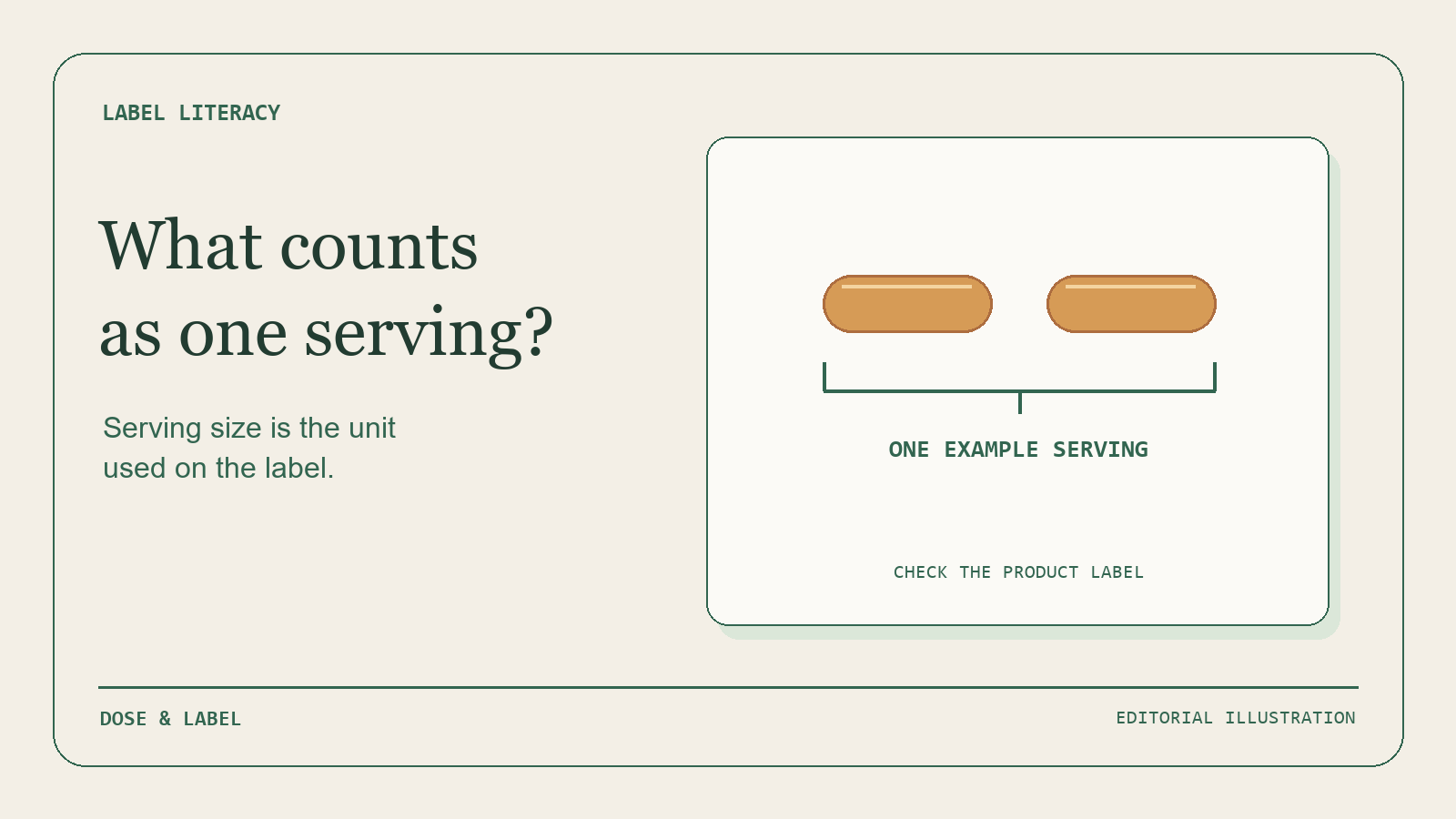
Serving size is a labeling unit. It tells the reader the quantity of capsules, tablets, packets, scoops, or liquid that the panel uses as its reference point. It is not a personalised recommendation, a promise of effect, or a shortcut for deciding whether a product is appropriate for a particular person.
Read amounts in their stated unit
If a label lists "Serving Size: 2 capsules," then an amount shown as 400 mg is normally 400 mg for those two capsules together, not 400 mg in each capsule. To understand the amount in one capsule, the reader would need to divide only when the ingredients are evenly distributed and the label gives no different instruction.
The U.S. Food and Drug Administration's dietary-supplement labeling guide explains that a Supplement Facts panel includes serving size, the number of servings per container, dietary ingredients, and amounts per serving. That structure is why the serving-size line should be read before comparing two products.
Servings per container answers a different question
Servings per container indicates how many labeled servings the package contains. It helps distinguish a 30-capsule bottle with a one-capsule serving from the same-sized bottle with a two-capsule serving. Neither format is automatically better; the useful comparison is the declared amount per serving, the serving instruction, and the total number of servings available.
Why a serving is not a personal dose
A label groups information for communication and regulatory purposes. It does not account for a reader's health status, medicines, allergies, pregnancy status, age, or other individual factors. The FDA notes that supplement labels present serving size, servings per container, dietary ingredients, and amounts per serving; it does not pre-approve dietary supplements for safety and effectiveness before they are marketed.
So a serving-size line can help a reader understand what the label is saying, but it cannot answer whether that amount is suitable for every person or goal. Questions involving safety, interactions, or individual use belong with an appropriately qualified health professional.
A quick label-reading sequence
- Read the serving size first.
- Confirm whether each listed amount is per serving or per individual unit.
- Check servings per container to understand the package total.
- Read the directions and the other-ingredients list separately.
- Keep label interpretation separate from assumptions about individual suitability or product performance.
Serving size is a small line with a large job: it anchors the label's arithmetic. Reading it first makes the rest of the panel easier to interpret without turning a packaging convention into a health claim.