Label Literacy
How to Read a Supplement Facts Panel, Line by Line
A practical guide to reading serving size, amounts per serving, % Daily Value, proprietary blends and other ingredients on a Supplement Facts panel.
We distinguish documented facts, reasonable inferences and missing information. Educational only; not medical advice.
A Supplement Facts panel is a starting point, not a quality verdict.
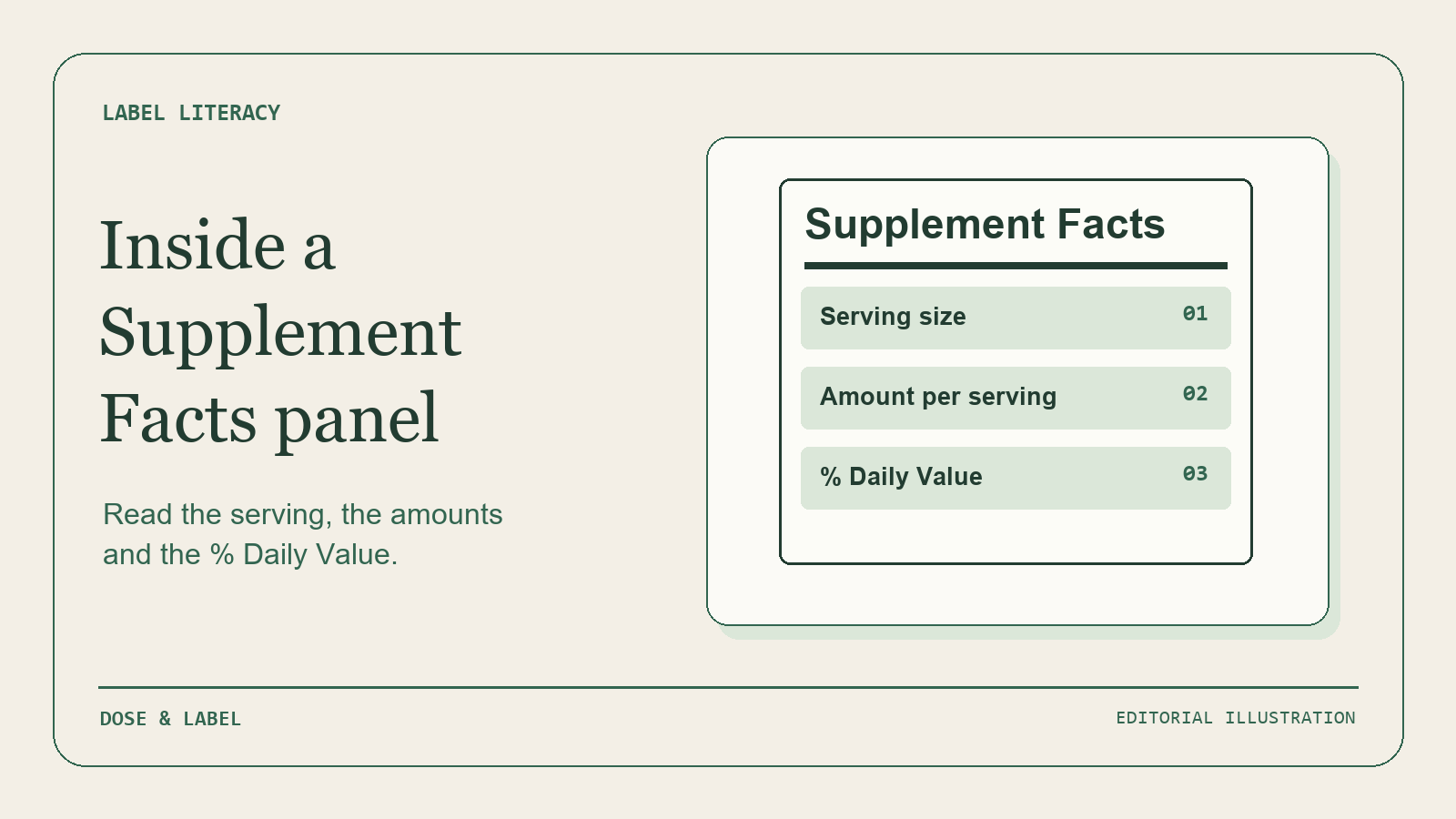
Start with serving size. All quantities on the panel are amounts per serving, not automatically per capsule, scoop or gummy. If directions recommend multiple units, the listed dose may refer to the full recommended serving rather than one unit.
Then read the ingredient line itself. For vitamins and minerals, the label commonly gives the amount and % Daily Value. A %DV describes how much a serving contributes to the Daily Value for a nutrient with an established value; it is not a personalised target, and it does not rate a product’s quality.
For botanicals and other ingredients without an established Daily Value, the panel can list an amount but no %DV. That number can still be useful, but interpretation depends on the form, the plant part where relevant, and the amount actually used in the research being discussed. A name alone does not establish equivalence across products.
Look for the difference between dietary ingredients and “Other ingredients.” The Supplement Facts panel lists dietary ingredients. The separate ingredient statement usually lists non-dietary components such as capsule materials, flavors, binders, or sweeteners. They serve different functions and belong to different parts of the label.
Proprietary blends require extra care. Under U.S. labeling rules, a proprietary blend may list a total weight and its ingredients in descending order of predominance by weight, while individual component amounts can remain undisclosed. That makes it harder to compare a specific ingredient amount with a study or with another product.
Finally, distinguish label information from product testing. A label tells you what a company says is in the product; a certificate of analysis or finished-product test may address a different question, depending on its scope, batch and method. Neither should be assumed to answer every quality question on its own.
The U.S. Food and Drug Administration’s labeling guide outlines the required structure of Supplement Facts panels, including serving size, amounts per serving and ingredient declarations. The NIH Office of Dietary Supplements also notes that labels can help identify ingredients and doses, but do not by themselves determine overall quality.
Sources
FDA, Dietary Supplement Labeling Guide: Chapter IV. Nutrition Labeling. https://www.fda.gov/food/dietary-supplements-guidance-documents-regulatory-information/dietary-supplement-labeling-guide-chapter-iv-nutrition-labeling
NIH Office of Dietary Supplements, Background Information: Dietary Supplements. https://ods.od.nih.gov/factsheets/dietarysupplements-Consumer/